Welcome to Recast! We are so excited to partner with you to build your MMM.
During implementation, our goal is simple: build your model and set your team up for success. We want you to feel confident in the model results. We’ll make sure you can refresh the model on an ongoing basis and that you’re comfortable navigating the dashboard and interpreting performance.
By the end of implementation, you’ll be ready to take meaningful action with your impact team based on clear, reliable insights.
✅ Implementation Objectives
During the implementation journey, our main objectives will be to:
-
Establish Our Core Team:
Meet regularly with your Recast team throughout the implementation roadmap to ensure strong collaboration and effective support at every key milestone. -
Confirm Your Model Inputs:
Review your initial data submission, provide recommendations, and deepen our understanding of your customer journey to ensure your model is configured accurately from the start. -
Dig Deeper into Your Business:
Gain a clear understanding of your business goals, what success looks like for you, and align on a shared success plan to guide our partnership. -
Confidently Progress to Acceptance:
Deliver a Benchmark Model, identify any gaps, and refine through our structured iteration process until we reach model acceptance. -
Implementation to Impact:
Seamlessly transition from implementation to your dedicated Impact team, who will serve as your ongoing partners and points of contact at Recast to drive continued value.
📆 Implementation Roadmap
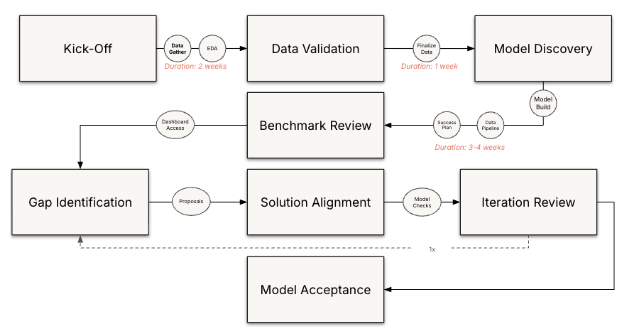
Implementation is made up of several key phases. The estimated timing of each is included below. However, each customer and model is different and your timeline may vary depending on data quality and model complexity. Your Implementation Leads will provide a confirmed timeline for your model(s) once we’ve kicked off and received your initial data.
⌛ Implementation Timeline
For more information on roles, see Establishing our Core Team.
|
Key Step |
Duration |
Details |
Participants |
|---|---|---|---|
|
Kickoff |
One week |
Your Implementation team will set up a kickoff call with you and your team. During kickoff, we'll discuss:
|
|
|
Data Collection |
Two weeks |
The timeline for data collection is driven by the client team. We set an expectation for the delivery of the initial data within the two weeks post kickoff. See our Data Guide for information on data required and best practices for formatting your data. |
|
|
Data Validation |
One week |
We will review your initial data pass, confirm the inputs you have shared and provide recommendations for any updates (e.g. aggregating low spend channels, reviewing promotional dates) |
|
|
One week |
Your Recast Implementation team will walk through an exercise with your core team to understand more about your customer journey & channel taxonomy. This will assist how we handover to the model builders to configure the model. |
|
|
|
Model Build |
Three to four weeks |
Our model building team will configure your model(s) with your data and inputs. During this time we will still use our weekly syncs to set up your Data Pipeline & align on a Mutual Success Plan. We will also discuss Recast’s GeoLift & Incrementality testing during this time. |
|
|
One week |
Your Recast team will deliver your initial insights in the Recast platform and enable your access to the dashboard. |
|
|
|
One week |
We will walk through your feedback on the initial model and align on solutions for addressing model gaps |
|
|
|
Model Iterations |
Varies by customer (up to two iterations) |
With input from your team, the Recast team will iterate on your model configuration to align with business context and acceptance criteria. |
|
|
One week |
Recast will support a readout on the final accepted model to your team. |
|
|
|
One Week |
The Recast Impact team will walk you through recommendations and next steps, aligned with your mutual success plan, and schedule training sessions to begin leveraging the platform effectively. |
|
ℹ️ Example Implementation Timeline
Note: your timeline may vary based on things like data readiness, team availability, etc.